Stop looking at that supermarket loaf with its bleached flour and chemical stabilizers. It is a structural failure. We are here to conduct a comprehensive Spelt Bread Audit to reclaim the ancient, nutty glory of Triticum spelta. Spelt is not just a grain; it is a high-performance biological machine packed with complex polyphenols and a fragile gluten matrix that requires precision engineering. When you tear into a properly executed spelt boule, the aroma should be an aggressive olfactory assault of toasted hazelnuts and fermented honey. The crust must shatter like tempered glass, revealing a crumb that is airy yet substantial. This is the gold standard of rustic baking. If your current loaf feels like a dense brick or a flavorless sponge, your infrastructure is compromised. We are going to strip your technique down to the studs, recalibrate your hydration levels, and rebuild your fermentation protocol from the ground up. Prepare to transition from a mere home cook to a culinary infrastructure auditor.
THE DATA MATRIX
| Metric | Specification |
|---|---|
| Prep Time | 30 Minutes (Active) |
| Execution Time | 18 to 22 Hours (Passive Fermentation) |
| Yield | 1 Large Boule (Approx. 850g) |
| Complexity | 7/10 |
| Estimated Cost per Serving | $0.85 USD |
THE GATHERS
Ingredient Protocol:
- 500g / 4 cups Whole Grain Spelt Flour
- 375ml / 1.5 cups Filtered Water (Heated to 32C / 90F)
- 10g / 2 tsp Fine Sea Salt
- 3g / 1 tsp Active Dry Yeast
- 15ml / 1 tbsp Raw Honey (To fuel initial microbial activity)
- 30ml / 2 tbsp Extra Virgin Olive Oil (To lubricate the gluten strands)
Section A: Ingredient Quality Audit:
Sub-par raw materials are the primary cause of structural collapse in ancient grains. If your spelt flour smells musty or lacks a vibrant tan hue, the lipids have oxidized; discard it immediately. Spelt gluten is more water-soluble and heat-sensitive than modern wheat. If your dough feels excessively viscous and refuses to hold a shape, your flour likely has a low protein content. The fix: Incorporate a "stretch and fold" sequence every 30 minutes during the first two hours to manually align the protein chains. If your yeast fails to aerate the mixture within 15 minutes of blooming, your water temperature was likely too high, denaturing the enzymes. Always use a digital thermometer to verify your thermal inputs.
THE MASTERCLASS

1. The Hydration Phase
Combine your filtered water, honey, and yeast in a ceramic bowl. Allow the mixture to bloom until a frothy foam appears on the surface. Gradually incorporate the spelt flour using a sturdy Danish dough whisk or a silicone spatula. You are looking for a "shaggy mass" where no dry pockets remain.
Pro Tip: Use a digital scale for all measurements. Volume-based measuring is the enemy of consistency. The science here involves the autolyse process, where flour enzymes begin breaking down starches into simple sugars before the mechanical kneading begins.
2. The Lubrication and Integration
Add the sea salt and olive oil to the dough. Spelt requires careful handling; do not overwork it. Use a bench scraper to fold the dough over itself. The oil will infuse the dough, creating a more supple texture and extending the shelf life of the final crumb by slowing down starch retrogradation.
Pro Tip: The salt must be added after the initial hydration to prevent it from drawing moisture away from the yeast too early. This ensures maximum CO2 production for a superior rise.
3. The Cold Fermentation Protocol
Place the dough in a lightly oiled container and cover it tightly. Transfer it to the refrigerator for 12 to 18 hours. This slow, cold fermentation allows organic acids to develop, which provides that signature piquant sourdough-adjacent flavor profile without the need for a starter.
Pro Tip: Cold fermentation slows down yeast activity while allowing protease enzymes to mellow the gluten. This results in a bread that is significantly easier to digest and possesses a more complex polyphenol map.
4. The Final Shaping and Tension
Turn the cold dough onto a lightly floured surface. Use your bench scraper to tension the surface of the loaf by pulling it toward you in a circular motion. This creates a "skin" that will trap gases and allow for a dramatic oven spring. Place the loaf in a proofing basket (banneton) for its final 60-minute rise.
Pro Tip: Creating surface tension is a mechanical necessity. Without it, the CO2 will escape through the top of the loaf, resulting in a flat, dense disc rather than a proud, rounded boule.
5. The Thermal Execution
Preheat a heavy Dutch oven at 245C (475F) for at least 45 minutes. Carefully drop the dough into the preheated vessel and score the top with a sharp blade. Bake covered for 25 minutes, then uncovered for another 15 minutes to render a deep, mahogany crust.
Pro Tip: The Dutch oven acts as a steam chamber. The trapped moisture keeps the "skin" of the dough moist, allowing it to expand fully before the Maillard reaction hardens the crust into its final form.
Section B: Prep & Timing Fault-Lines:
The most common human error in a Spelt Bread Audit is rushing the cooling process. If you cut into the loaf while it is still steaming, you will cause the internal moisture to flash-evaporate, leaving you with a gummy, rubbery interior. You must wait at least 90 minutes. Another fault-line is "over-proofing" in a warm kitchen. If the dough doubles and then begins to deflate, the gluten structure has been compromised by excess gas pressure. The fix: Shorten your room-temperature proofing time or move the dough to a cooler zone in the kitchen.
THE VISUAL SPECTRUM
Section C: Thermal & Visual Troubleshooting:
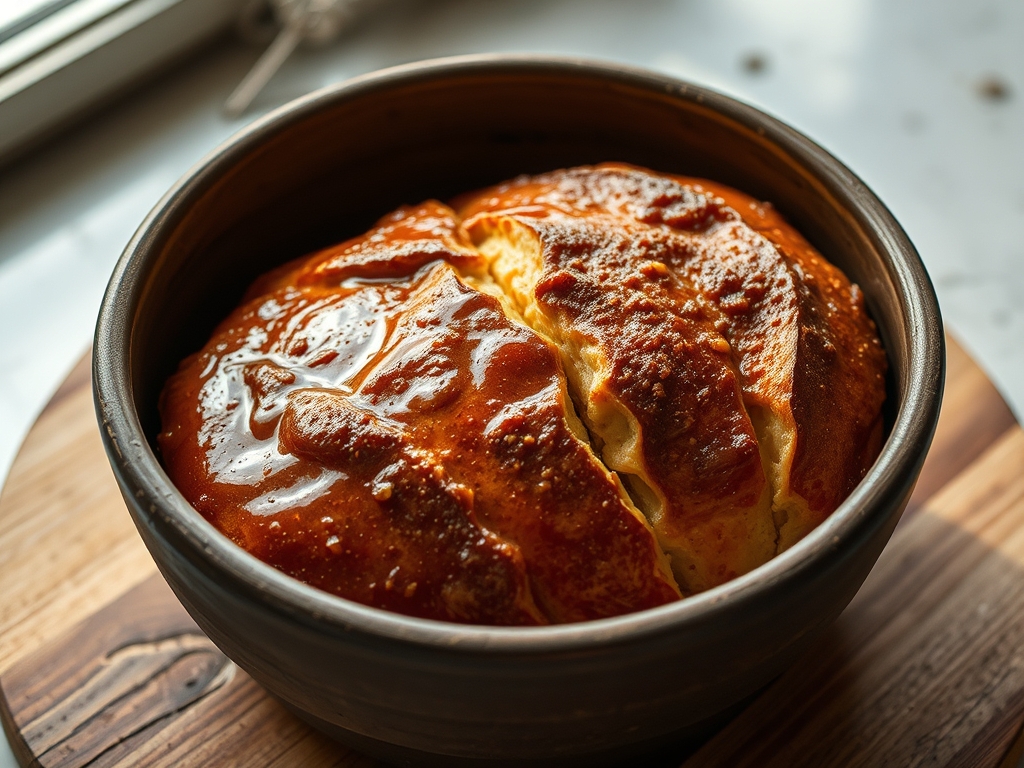
Examine the Masterclass photo above. Notice the "ear" or the jagged ridge where the loaf was scored; this indicates a successful oven spring. If your loaf is pale and dull, your oven temperature was too low, or you lacked sufficient sugars for the Maillard reaction. If the crust is burnt but the center is raw, your Dutch oven was too close to the heating element. Solutions: Place a baking sheet on the rack below your Dutch oven to deflect direct radiant heat. For a more vibrant sheen, you can lightly mist the dough with water before closing the lid; this encourages the caramelization of surface starches.
THE DEEP DIVE
Macro Nutrition Profile:
Spelt is a nutritional powerhouse compared to modern wheat. A single serving provides approximately 4g of fiber, 5g of protein, and a significant dose of magnesium and zinc. Its complex carbohydrates ensure a low glycemic index, preventing the insulin spikes associated with white bread.
Dietary Swaps:
- Vegan: This recipe is naturally vegan if using maple syrup or agave instead of honey.
- Keto: Spelt is not keto-friendly due to its high starch content.
- Gluten-Free: Spelt contains gluten. For a GF alternative, you must use a blend of sorghum and buckwheat flours with xanthan gum as a structural binder.
Meal Prep & Reheating Science:
To maintain the molecular structure, store the bread in a paper bag for the first 24 hours. For long-term storage, slice the loaf and freeze it in an airtight bag. To reheat, use a toaster or a 175C (350F) oven for five minutes. This "recrisps" the crust through a secondary dehydration process while the interior starch granules re-gelatinize, restoring the original texture.
THE KITCHEN TABLE
Why does my spelt bread always turn out so dense?
You are likely over-kneading or under-hydrating. Spelt gluten is fragile; use the "stretch and fold" method instead of aggressive kneading. Also, ensure your water-to-flour ratio is at least 70 percent to allow for proper gas expansion.
Can I substitute all-purpose flour for spelt?
You can, but the hydration requirements will change. Modern wheat absorbs more water and has stronger gluten. If you switch, you will lose the specific nutty polyphenol profile and the delicate crumb that defines a true Spelt Bread Audit.
What is the best way to get a crispy crust?
Steam is the secret. Using a preheated Dutch oven traps the moisture released by the dough. This moisture gelatinizes the surface starches, which then bake into a thin, crisp, and highly flavorful crust during the final uncovered phase.
How do I know when the fermentation is actually finished?
Use the "poke test." Gently press your finger into the dough. If it springs back slowly and leaves a slight indentation, it is ready. If it snaps back instantly, it needs more time. If it collapses, it is over-proofed.