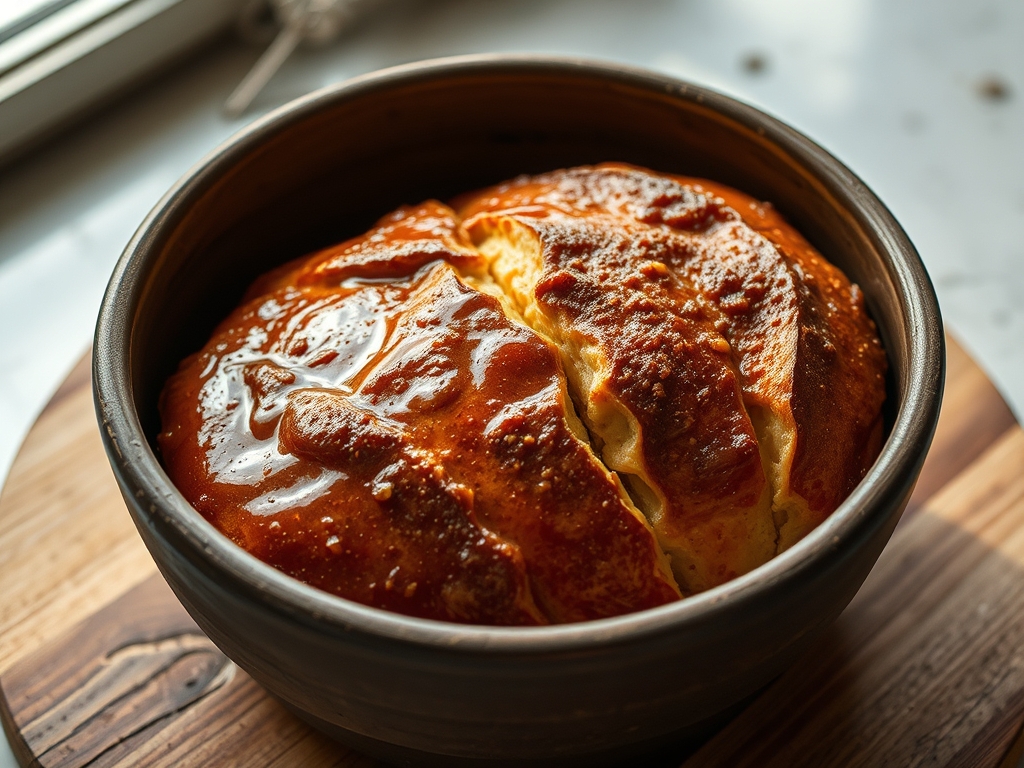
Listen to the sound of a structural masterpiece under thermal stress. It is the rhythmic crackle of the cooling crust; a symphony of microscopic fractures occurring as the crumb stabilizes. This is the ultimate Dutch Oven Boule. We are not merely baking bread; we are conducting a high-stakes engineering project involving hydration ratios and carbon dioxide sequestration. The goal is a crust so shattered and dark it borders on the obsidian, protecting a crumb that is airy, translucent, and elastic. To achieve this, we must harness the power of radiant heat and steam containment. The Dutch oven acts as a pressurized combustion chamber, trapping the moisture evaporating from the dough to gelatinize the surface starches before they set. This creates that signature gloss and blistering. If you have been producing pale, dense, or uninspired loaves, your technical protocol is flawed. It is time to audit your workflow, recalibrate your fermentation window, and demand more from your flour. Let us begin the tear-down of the artisanal process.
THE DATA MATRIX
| Metric | Specification |
|---|---|
| Prep Time | 20 Minutes (Active) |
| Execution Time | 18 to 24 Hours (Fermentation Included) |
| Yield | 1 Large Loaf (approx. 850g) |
| Complexity | 4 / 10 |
| Estimated Cost per Serving | $0.45 USD |
THE GATHERS
Ingredient Protocol:
- 500g / 3.75 cups Bread Flour (Minimum 12.7% protein)
- 375ml / 1.5 cups Filtered Water (Room temperature, 21C)
- 10g / 2 tsp Fine Sea Salt
- 3g / 1 tsp Instant Yeast
- 15ml / 1 tbsp Extra Virgin Olive Oil (Optional for crumb softness)
Section A: Ingredient Quality Audit:
The most common failure point is the protein content of the flour. If you use standard All-Purpose flour, the gluten network will lack the structural integrity to aerate properly during the final proof. To fix this, add 10g of Vital Wheat Gluten to your dry mix. Furthermore, tap water containing high chlorine levels can inhibit yeast activity. Always use filtered water to ensure the biological agents remain aggressive. If your yeast is sluggish, perform a bloom test in warm water with a pinch of sugar; if it does not foam within five minutes, discard and replace.
THE MASTERCLASS
1. The Initial Hydration and Autolyse
Combine your flour and water in a large glass bowl until no dry streaks remain. Allow this shaggy mass to rest for thirty minutes. This phase allows the flour to fully hydrate and enzymes to begin breaking down starches into fermentable sugars.
Pro Tip: Use a digital scale for this step. Volumetric measurements are notoriously inaccurate; a "cup" of flour can vary by 30 grams depending on how it is packed, which will completely alter your hydration percentage.
2. Salt Integration and Bulk Fermentation
Sprinkle the salt and yeast over the dough. Use a "pincer" method to fold the dough over itself, ensuring even distribution. Cover the bowl with a silicone lid or damp cloth and let it sit at room temperature for 12 to 18 hours. You are looking for the dough to double in size and exhibit a bubbly, viscous surface.
Pro Tip: A bench scraper is your best friend here. Use it to scrape the sides of the bowl to ensure every gram of dough participates in the fermentation process.
3. Structural Tensioning
Turn the dough onto a lightly floured surface. Do not degas the dough aggressively. Gently fold the edges toward the center to create a tight skin. This surface tension is what allows the loaf to expand upward rather than outward.
Pro Tip: This is where you infuse the dough with strength. Use your hands to pull the boule toward you across the counter; the friction against the surface will tighten the outer membrane of the dough.
4. The Final Proof
Place the shaped boule into a proofing basket or a bowl lined with a floured tea towel. Let it rest for 60 to 90 minutes. While this happens, place your heavy cast iron Dutch oven into the oven and preheat to 245C (475F). The pot must be screaming hot.
Pro Tip: Use a saucier or a small spray bottle to mist the top of the dough right before it goes into the pot. This extra moisture delays the crust formation, allowing for maximum "oven spring."
5. The Thermal Execution
Carefully transfer the dough into the preheated Dutch oven. Score the top with a sharp blade to control the expansion. Bake with the lid on for 30 minutes, then remove the lid and bake for another 15 minutes to render the crust into a deep mahogany brown.
Pro Tip: Professional bakers use a lame for scoring, but a fresh razor blade works perfectly. A deep, 45-degree angle cut allows the steam to escape and creates the "ear" seen in the reference photo.
Section B: Prep & Timing Fault-Lines:
Temperature is the most volatile variable. If your kitchen is below 20C, the bulk fermentation might require 24 hours. Conversely, in a humid 30C environment, the dough may over-proof in 8 hours, resulting in a collapsed, sour loaf. Use a probe thermometer to monitor the internal temperature of the dough; the "sweet spot" for flavor development is 22C to 24C.
THE VISUAL SPECTRUM
Section C: Thermal & Visual Troubleshooting:
The reference photo showcases a "shattered" crust with distinct color gradients from golden amber to charred espresso. If your Dutch Oven Boule looks dull or matte, you likely lacked sufficient steam during the first 20 minutes of baking. If the bottom is burnt while the top is pale, place a baking sheet on the rack below the Dutch oven to deflect direct radiant heat. A "tight" or dense crumb indicates under-fermentation; look for the "windowpane" effect where the dough can be stretched thin enough to see light through it without tearing.
THE DEEP DIVE
Macro Nutrition Profile:
A standard slice (approx. 50g) contains roughly 130 calories, 26g of carbohydrates, 4g of protein, and 0.5g of fat. While high in complex carbs, the long fermentation process breaks down much of the phytic acid, making the nutrients more bioavailable than in commercial bread.
Dietary Swaps:
- Vegan: This recipe is naturally vegan.
- Keto: Replace wheat flour with a blend of almond flour, vital wheat gluten, and oat fiber (though the structural chemistry will change significantly).
- Gluten-Free: Use a high-quality 1-to-1 GF bread flour containing xanthan gum and increase hydration by 10%.
Meal Prep & Reheating Science:
To maintain the molecular structure, never refrigerate bread; this accelerates staling through starch retrogradation. Store at room temperature in a paper bag for 48 hours. To revive a stale loaf, mist the crust with water and bake at 175C for 10 minutes to re-gelatinize the starches.
THE KITCHEN TABLE
Why is my crust soft after cooling?
As the bread cools, moisture moves from the crumb to the crust. If you do not let the boule cool on a wire rack, the bottom will steam itself. Ensure total airflow during the two-hour cooling period.
Can I use a cold Dutch oven?
You can, but you will lose the immediate "thermal shock" required for a massive oven spring. Preheating the vessel ensures the base of the loaf starts cooking and rising the second it touches the cast iron.
What does scoring actually do?
Scoring provides a "planned weakness" in the dough's skin. Without it, the steam will force its way out of the weakest point, usually resulting in an unsightly blowout at the base of the loaf.
How do I get more bubbles in the crust?
Those tiny blisters, or "micro-blisters," are a result of a cold secondary fermentation. After shaping, put the dough in the refrigerator for 4 hours before baking. The cold environment changes how the CO2 interacts with the surface.